Vampire Survivors Is the Best Bad Game I've Ever Played
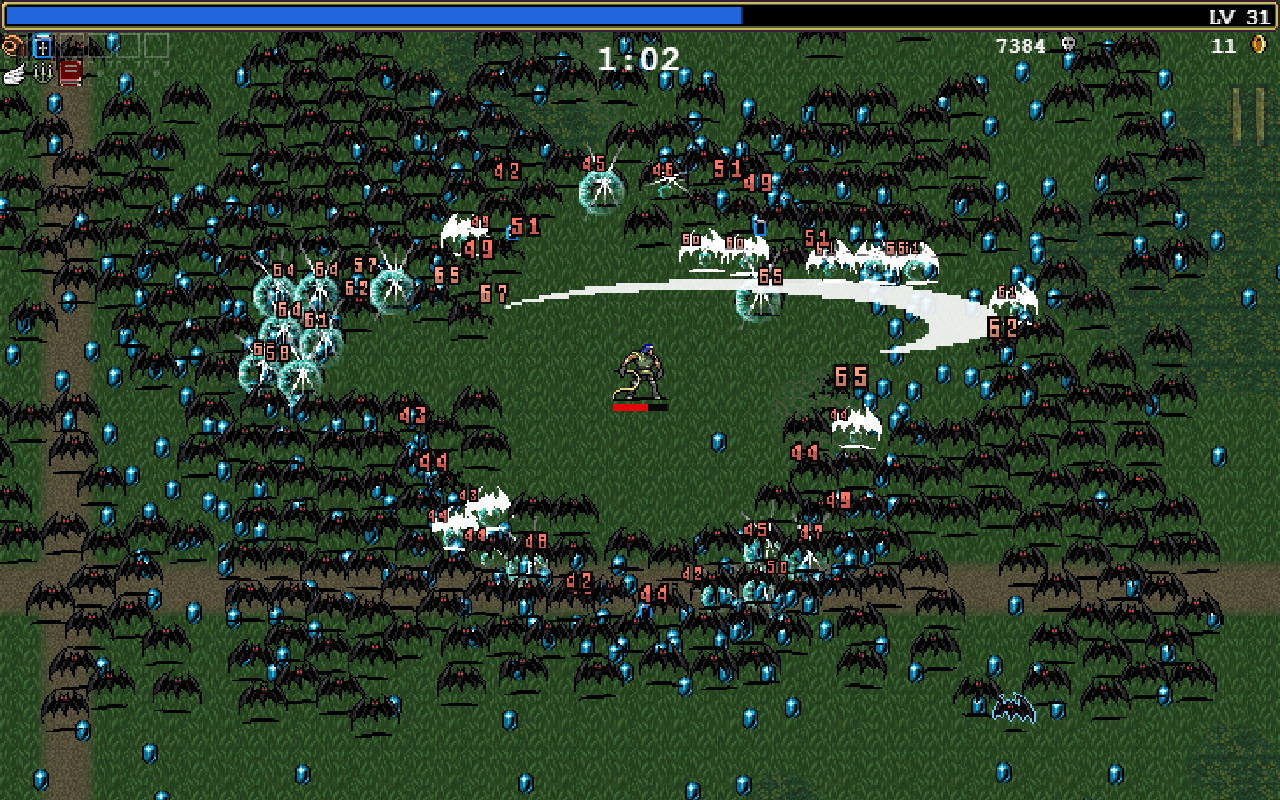
Vampire Survivors shouldn't be good. The art is rough pixel work that looks like a game jam submission. The music loops aggressively. There is no story, no dialogue, no cutscenes. The controls are — and this is the full list — move in a direction. Your weapons fire automatically. You don't aim. You don't press a single attack button. By every conventional measure of what makes a game feel crafted, poncle's 2022 release should register as a throwaway.
And yet. Fifty hours gone. Stage evolutions unlocked at 2 a.m. That specific, slightly feverish feeling of running one more character. Vampire Survivors is the best bad game I've played in years — genuinely thrilling in its core loop, genuinely unpolished in almost everything surrounding it. Whether that trade is worth it depends on a few things, and not all of them flatter the game.
What It Actually Is
Each run puts you in a large open area swarming with enemies. They pour in continuously, escalating in density until the screen is barely visible through the particle effects. You survive for thirty minutes — that's the goal — by collecting experience gems dropped by enemies, leveling up, and picking from a small random selection of weapons and passive items every time you gain a level. Weapons fire on their own. You just move.
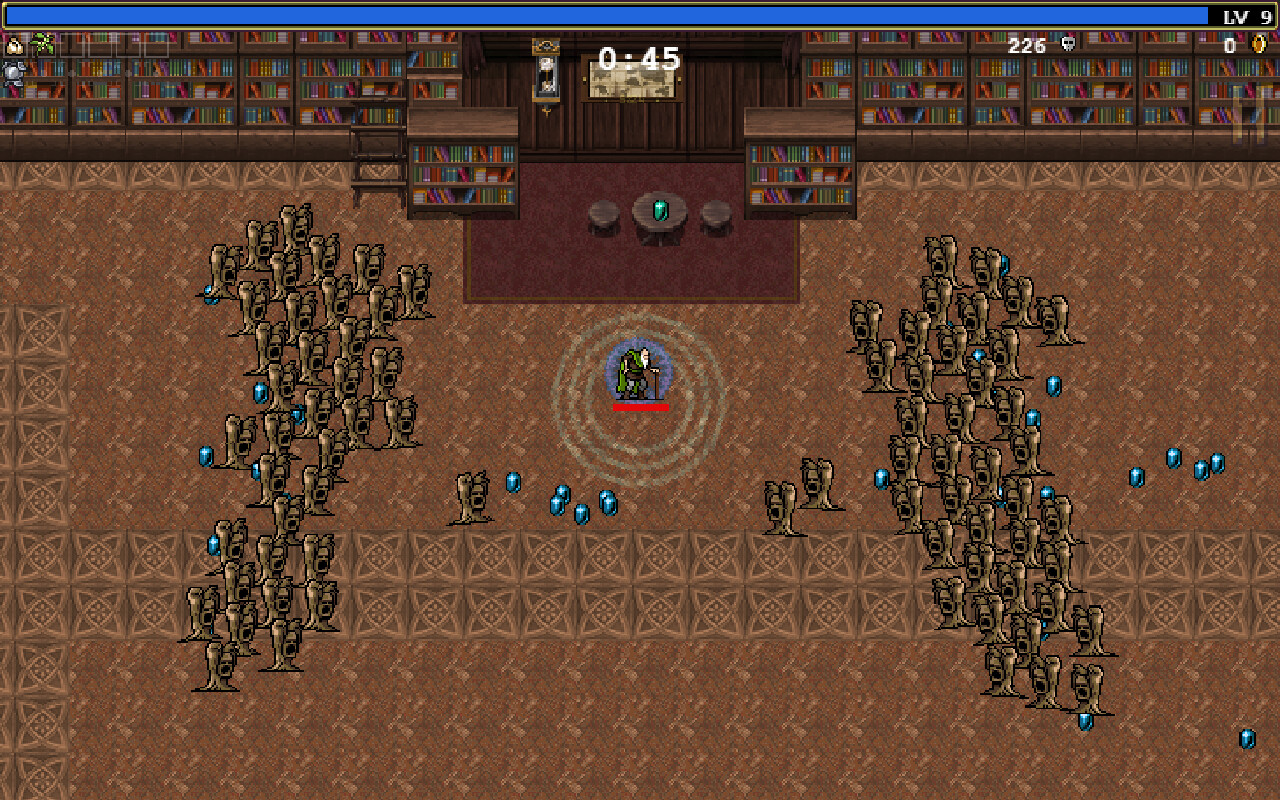 Scene from Vampire Survivors.
The depth emerges from item interactions. A whip plus a hollow heart can combine into a single evolved weapon with different behavior. Stack the right passives and a handful of rotating projectiles can blanket an entire screen. There's a genuine theory-crafting layer here — certain builds are dramatically more powerful than others, and figuring out which combinations unlock which evolutions is the actual game. The in-game information about this is minimal, by design or oversight it's hard to say, but it pushes you toward community wikis faster than almost any game I can recall.
What poncle clearly understood is that the automation removes frustration from the feedback loop. You're not punished for missing a shot. You're rewarded for positioning well and building intelligently. That inversion — where the failure state is a build decision made ten levels ago rather than a button press just now — turns each death into a lesson rather than a gut punch.
The Part That Actually Holds Up
The build escalation is genuinely excellent. Early in a run, weapons feel modest, enemies are sparse, and the game is almost meditative. Then around the fifteen-minute mark something tips. A critical mass of projectiles, area effects, and passive multipliers locks in and suddenly the screen is a light show. That moment of transition — from scrappy survivor to unstoppable engine of destruction — is what every run is chasing. It lands consistently.
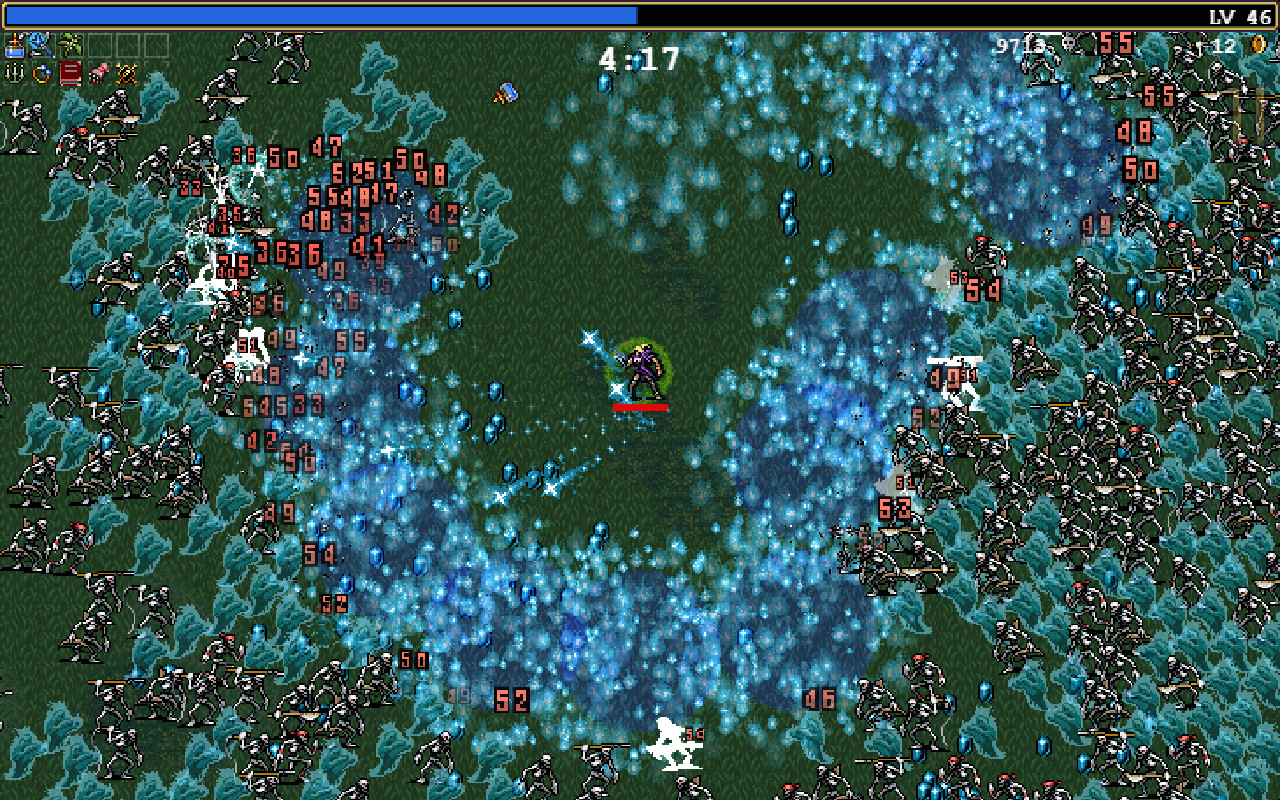 Scene from Vampire Survivors.
The character variety is broader than it first appears. Some characters start with specific weapons that push you toward particular builds. Others have passive bonuses that open up unusual strategies. The early roster feels a bit samey, but unlocking characters further in reveals poncle's actual range of design ideas. There's a character whose progression is essentially a soft puzzle. Another who changes how area-of-effect items scale. These aren't elaborate RPG archetypes, but they shift runs in meaningful ways.
The Rough Edges Are Real
Here's where I want to be honest in a way that some coverage of this game wasn't. The loop is compelling, but the game around the loop is thin in ways that occasionally curdle into tedium. Stages are large flat arenas with minimal environmental distinction. The later areas introduce new enemy types and visual themes, but they don't change how you move through the space. You're always doing the same thing: orbiting the center of a wave, kiting, picking up gems. The scenery shifts; the activity doesn't.
Unlocks are tied to a combination of run completion, hidden pickups, and some discovery conditions the game hints at cryptically. This works when you stumble onto something unexpected. It drags when you're grinding a specific stage for the third time trying to trigger a condition you found on a wiki. Vampire Survivors regularly mistakes opacity for depth. Some of that mystery is charming. Some of it is just friction dressed up as secrets.
The presentation is the most polarizing element and I land somewhere in the middle on it. The pixel art is functional rather than expressive — it communicates what things are without being interesting to look at. A game like Hades from Supergiant shows what you can do with a similar top-down action format and serious art direction. Comparing the two is unfair given the obvious resource gap, but it's also unavoidable when you're considering what Vampire Survivors is and isn't. The visual plainness isn't charming in the way that, say, Spelunky's deliberate simplicity is. It mostly just looks unfinished.
Accessibility and the Entry Point Problem
The first fifteen minutes of Vampire Survivors are probably the worst advertisement for what the game actually offers. A single character, a couple of weak weapons, waves that feel like a slow appetizer with no indication of the feast coming. The game's most enthusiastic defenders tend to be people who pushed past that opening — but pushing past it requires some faith that the game has earned.
This matters more than it might seem. Vampire Survivors made its name partly on accessibility: it's cheap, it runs on most hardware, early access exposure built the audience. But the actual onboarding is weirdly hostile for a game that seems designed to be immediately approachable. There's very little explanation of why certain weapons combine, how passive scaling works, or which character abilities are actually affecting your runs. For some players this discovery is the appeal. For others — and I think this is a larger group than the enthusiast coverage suggests — it's a wall.
What It Borrows and What It Made
The auto-shooter subgenre Vampire Survivors effectively launched — or at least crystallized — has produced a lot of followers by now. Magic Survival predates it, and Brotato, 20 Minutes Till Dawn, and a wave of others followed its commercial success. Looking at that lineage is instructive. Some successors added mechanical complexity: weapon aiming, active abilities, tower-defense hybrids. Some prioritized art and production value. Almost none of them replicated the specific dopamine rhythm of poncle's original.
That rhythm is hard to isolate but real. Part of it is pacing — the thirty-minute ceiling creates a natural arc that the imitators often fumble by either shortening or removing. Part of it is the exact ratio of randomness to build consistency, where most runs feel different enough to be interesting but familiar enough to feel like progress. Vampire Survivors didn't invent the ingredients, but it mixed them in a proportion that nobody has quite matched. That's worth acknowledging even while cataloguing its flaws.
The Verdict, Without Hedging
Vampire Survivors costs less than a coffee and runs in a browser. The question is never really whether it's worth the investment. The question is whether it belongs in your active rotation or your guilt backlog — those games that were interesting for a week and then became monuments to unfinished curiosity.
If the loop description above sounds appealing — and particularly if the auto-battler, no-aim-required format sounds freeing rather than empty — it absolutely belongs in your active rotation. The lack of visual polish matters less the deeper you get, and the build variety sustains more runs than you'd expect from something this structurally simple. If you're someone who needs a game to earn your attention with its first impression, Vampire Survivors will lose you before it wins you. That's not a knock on the player, it's a real design limitation.
Poncle made something that shouldn't exist: a genuinely compelling game built almost entirely out of parts that shouldn't work. The pixel art is amateur. The sound design is repetitive. The UI ranges from minimal to absent. None of that stopped it from being one of the defining releases of 2022, and none of it stops it from being, still, one of the more interesting arguments in recent years for what a game strictly needs to be good. It needs one thing done right. Everything else is negotiable. Vampire Survivors is proof of that, and also a warning about how far that principle can stretch.
Editorial scoring
Reader Q&A
How long does it take to finish Vampire Survivors Is the Best Bad Game I've Ever Played?
Main story runs around 47 hours depending on how thoroughly you explore. Completionists can spend 2-3× that.
Is Vampire Survivors Is the Best Bad Game I've Ever Played good for newcomers to Roguelike Auto-shooter?
It depends. The systems are deep but the tutorial does a fair job. Veterans of Roguelike Auto-shooter will feel at home faster.
Which platform should I play Vampire Survivors Is the Best Bad Game I've Ever Played on?
Steam Deck handles this title well — verified compatibility on most recent patches.
Was Vampire Survivors Is the Best Bad Game I've Ever Played worth the launch-day price?
Released in 2022, and as of writing it holds up. Wait for a sale if you're price-sensitive — major discounts arrive within 6 months.
Are there DLCs or expansions worth picking up?
The base game is complete; expansion DLC adds 10-15 hours of additional content if you want more.
What did Poncle get right (and what could be better)?
Strongest: art direction, audio design, set-piece variety. Weakest: late-game balance and a few persistent quest-log bugs.
Reader comments