Sekiro Doesn't Care If You're Having Fun
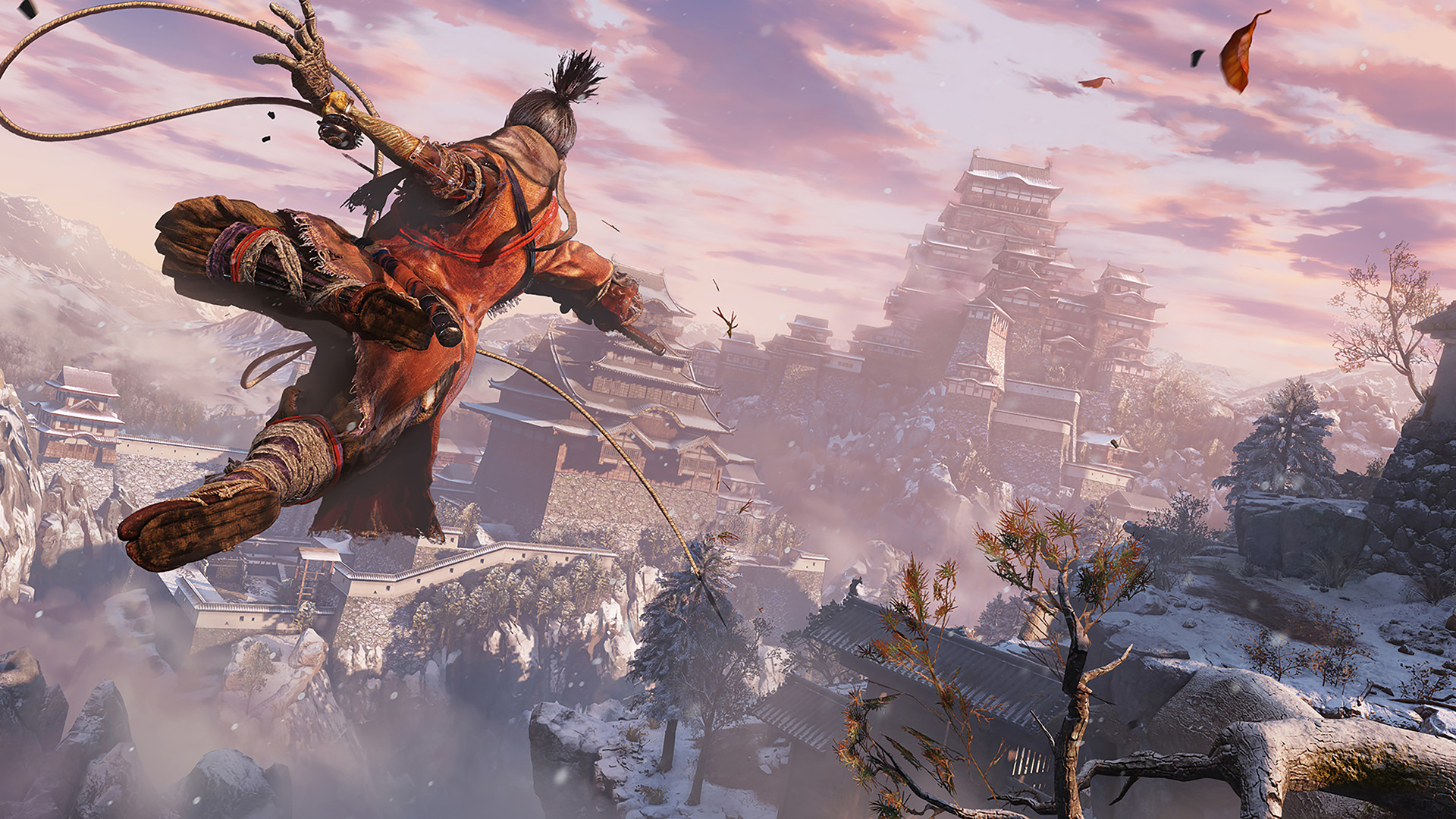
FromSoftware has never been especially interested in player comfort. That's not a criticism — it's basically a design philosophy. But Sekiro: Shadows Die Twice pushes that philosophy further than Dark Souls or Bloodborne did, because it removes most of the systems those games used to let you negotiate with the difficulty. No stat-leveling to grind past a wall. No summoning a friend to tank a boss. No equipping a heavier shield and turtling. What's left is one tool, used well or not at all: the sword.
The result is a game that's genuinely polarizing in a way that goes beyond the usual "is FromSoftware too hard" discourse. Sekiro asks a specific question — can you read attacks, time deflections, and manage posture — and it will repeat that question, calmly and without variation, until you either answer it or walk away. Some players will find that liberating. Others will find it airless. Both reactions are reasonable.
The Posture System Is the Whole Game
Sekiro's central mechanic works like this: every enemy has a posture gauge that fills when they block or absorb hits. Fill it completely, and you break their guard for an instant kill or a heavy blow. Your own posture works the same way — take too many hits without deflecting, and you're left open. The twist is that blocking poorly depletes your health and builds your posture simultaneously, while a well-timed deflection — tapping the block button just before impact — costs you almost nothing. The game isn't asking you to avoid damage. It's asking you to meet attacks head-on and redirect them.
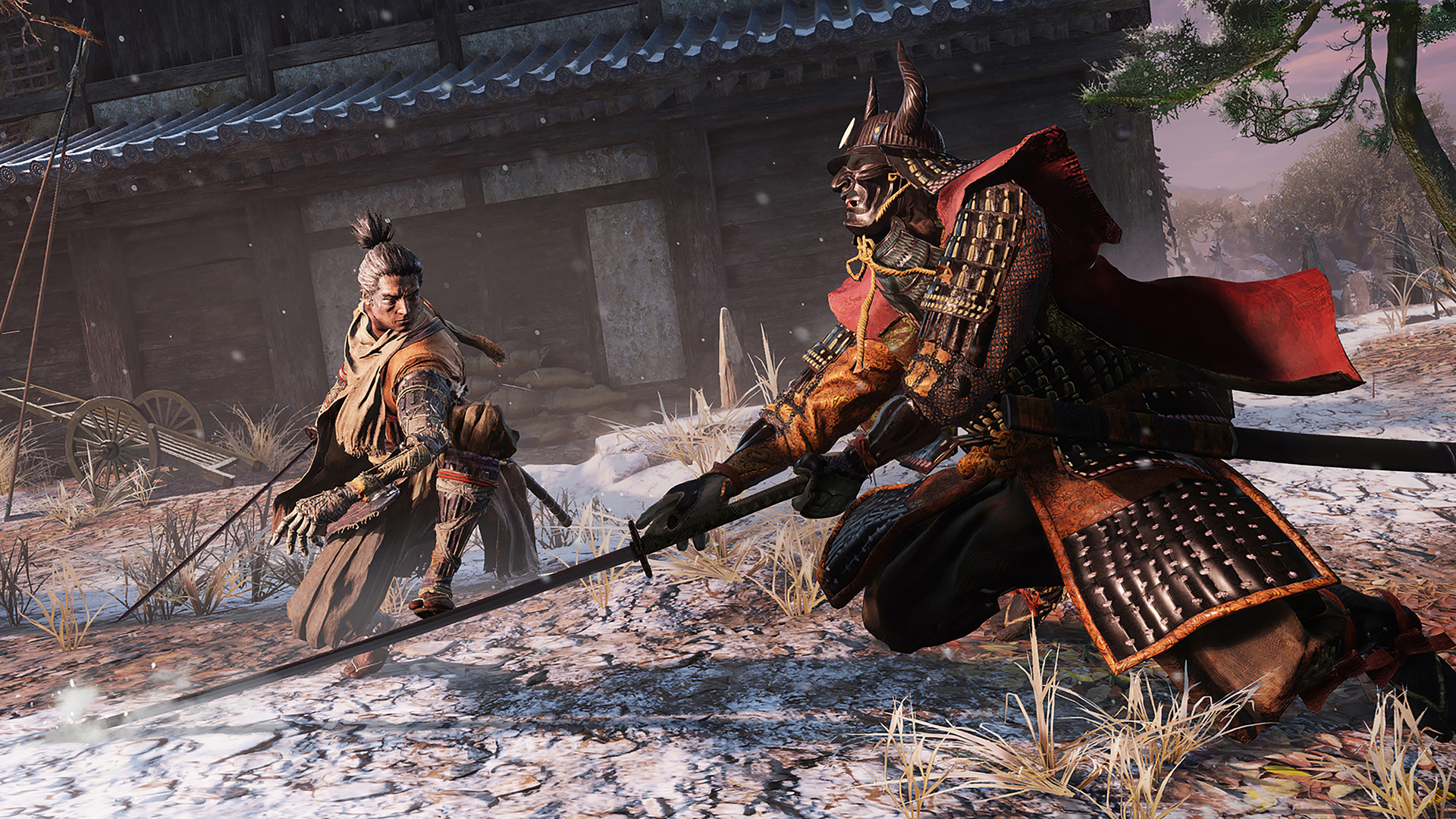 Scene from Sekiro: Shadows Die Twice.
This single mechanic does an enormous amount of work. Boss fights that look overwhelming at first become legible once you realize the goal isn't survival — it's relentless pressure. The Guardian Ape, which seems designed purely to make you feel helpless, becomes almost rhythmic once you stop retreating and start staying inside its attack windows. That shift in mindset, from evasion to interception, is the game's main lesson, and it takes most players several hours — and several deaths — to internalize.
Whether this system is brilliant or exhausting probably depends on how much you enjoy pure mechanical mastery for its own sake. There's no build variety to hide behind, no damage type to exploit. You learn the sword, or you stop playing. That's a genuine design choice, and it cuts both ways.
Combat Prosthetics: Good Idea, Uneven Execution
The shinobi prosthetic arm gives Wolf — the game's protagonist — a set of interchangeable tools: a grappling hook, shuriken, a firecracker that staggers enemies, an axe attachment that breaks shields. These are fun and occasionally essential. The firecracker is genuinely useful against certain beast-type enemies, and the axe attachment is almost mandatory against certain shield-bearing enemies in the mid-game.
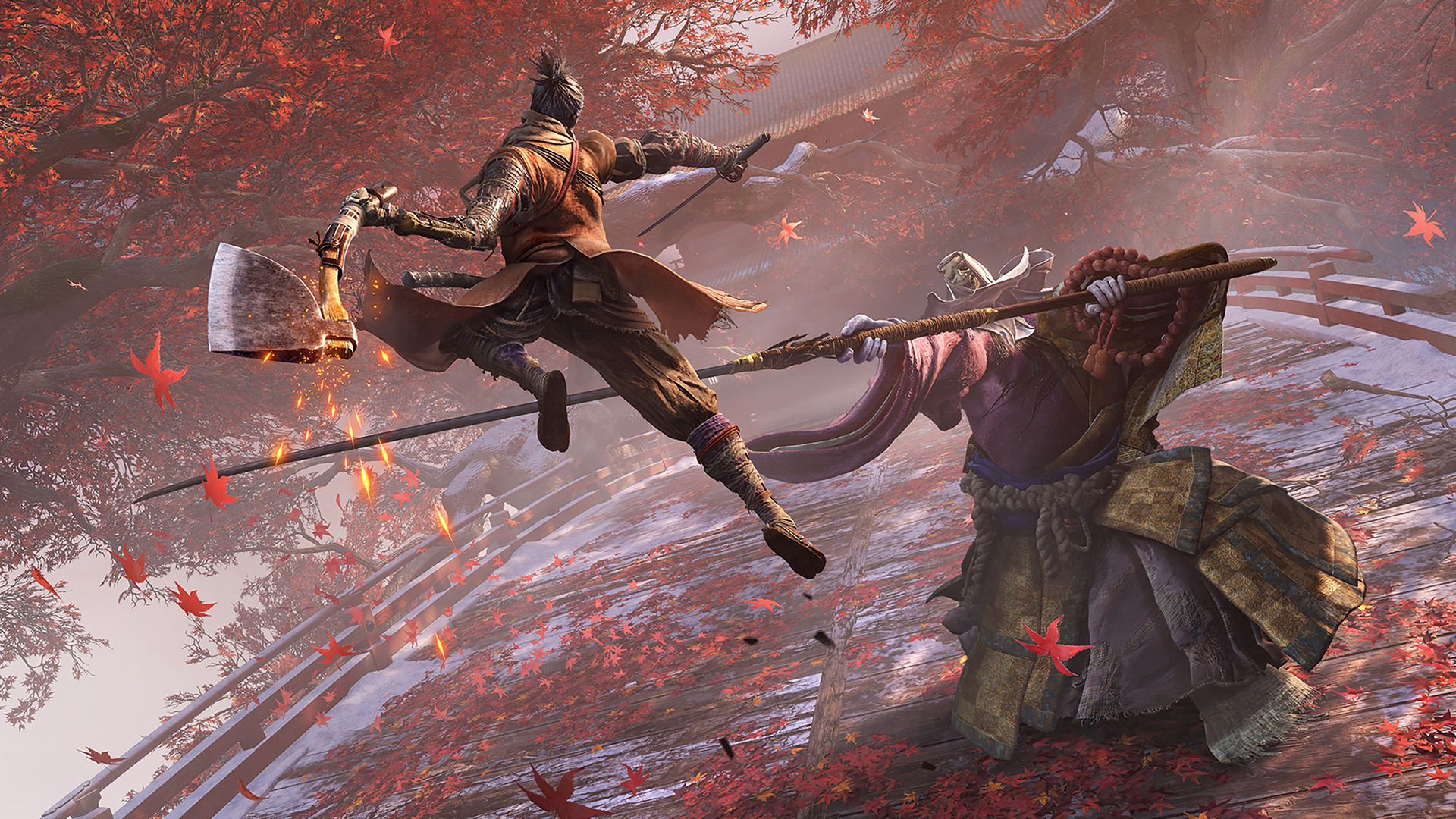 Scene from Sekiro: Shadows Die Twice.
The problem is that the prosthetics never quite integrate into combat the way the deflection system does. They feel supplemental rather than foundational — situational tools you remember to use when a specific vulnerability presents itself, rather than part of your second-to-second rhythm. A few prosthetics, like the flame vent, feel more like puzzle solutions than combat options. Which is fine, but it means the variety the prosthetic system promises doesn't fully materialize in practice.
The World Is Better Than You Might Remember
Ashina — the game's setting, a fictionalized feudal Japan — is one of FromSoftware's more coherent environments. The areas connect in ways that reward exploration: a drop through a certain floor reveals a shortcut you'll use for the rest of a section, a roof you've been running across turns out to overlook an area you'll reach much later. The grapple hook changes how you read vertical space — you stop thinking about terrain as a flat obstacle and start reading it for attachment points.
The environmental storytelling is also quieter and more restrained than in the Souls games, which isn't a complaint. Sekiro is less interested in cosmological lore delivered through item descriptions, more interested in what specific human characters want and why those wants are ruining everything. The NPC questlines — Owl, Emma, the various Ashina soldiers with names you keep forgetting — are stripped down compared to what Elden Ring would later do with similar material, but they're coherent enough to give the late-game its weight.
The grapple traversal is worth dwelling on for a moment. A lot of action games tack on traversal mechanics that feel disconnected from combat — Spider-Man's swing is exhilarating but it doesn't change how fights work. Sekiro's grapple bleeds directly into encounters. You use it to reposition mid-fight, to close distance on ranged enemies, to pull yourself onto a boss's flank. It's one of the cleaner examples of a movement mechanic that earns its place at every scale.
Where FromSoftware Gets It Wrong
There are a few bosses that feel like FromSoftware forgot what game they were making. Certain fights introduce tracking projectiles, large hitboxes, or multi-phase patterns that punish the aggressive posture-focused approach the entire game has taught you. The game isn't wrong to throw curveballs — but some of them feel like they belong in a different design tradition, where the answer is to level up or bring better gear. Here, there's nowhere to go. You just have to absorb the lesson and adapt, which is fine in theory and genuinely demoralizing in practice when the lesson is "this attack doesn't have a fair deflect window."
The death mechanic — you lose half your sen (currency) and half your accumulated experience on death, but can recover it by killing enemies in the area — works less well than it sounds. In the early and mid-game, when resources are tight, it creates a friction that feels meaningful. In the late game, when you're relatively resource-stable, it mostly creates mild inconvenience. The "Dragonrot" system, which ties NPC health to how often you use a resurrection mechanic, is more interesting as a concept than it is punishing in reality — most players can cure it fairly easily. It's the kind of system that feels like it was designed to matter more than it does.
Compared to What FromSoftware Did Before and After
Bloodborne is probably the better game for players who want a dark action title with more systemic flexibility — the rally mechanic, the trick weapons, the stat builds all give it more avenues. Elden Ring offers the widest possible entry point, with summons, abundant build variety, and enough open-world structure that you can simply avoid a difficult area for a while. Sekiro sits between those two poles: harder to approach than Elden Ring, more mechanically rigid than Bloodborne, but arguably more satisfying if the combat clicks for you.
The comparison to Nioh — Team Ninja's parallel approach to the same feudal Japan aesthetic — is worth making if you found Sekiro's lack of build variety alienating. Nioh 2 in particular offers the responsive parry timing of Sekiro alongside deep stat and equipment systems. They're not competing experiences so much as different answers to the same question about what this genre can be.
Who This Is Actually For
Sekiro does not compromise. It is, without equivocation, a game about learning one specific set of skills, applied under pressure, until they become reflexive. The narrative pays off for players who stay patient with it — the relationship between Wolf and Kuro is one of the more grounded motivations FromSoftware has built around — but the story is never why you're playing. You're playing because the deflection system eventually produces a state where you're reading a boss's attack string in real time and responding correctly, and that feeling is difficult to replicate elsewhere.
If that sounds appealing, Sekiro will give you enough to argue about for weeks. If it sounds like work without enough reward, the game will not meet you halfway. That's not a flaw in the design — it's a statement about what FromSoftware wanted to make. Whether that's admirable or infuriating probably says more about what you want from the medium than it does about the game itself.
Editorial scoring
Reader Q&A
How long does it take to finish Sekiro Doesn't Care If You're Having Fun?
Main story runs around 85 hours depending on how thoroughly you explore. Completionists can spend 2-3× that.
Is Sekiro Doesn't Care If You're Having Fun good for newcomers to Action-Adventure?
Yes — Sekiro Doesn't Care If You're Having Fun is a great entry point. The early hours teach the systems gradually and the difficulty curve is reasonable.
Which platform should I play Sekiro Doesn't Care If You're Having Fun on?
Steam Deck handles this title well — verified compatibility on most recent patches.
Was Sekiro Doesn't Care If You're Having Fun worth the launch-day price?
Depends on backlog. The replay value justifies the price for genre fans; casual players should wait for a 40%+ discount.
Are there DLCs or expansions worth picking up?
The base game is complete; expansion DLC adds 10-15 hours of additional content if you want more.
What did FromSoftware get right (and what could be better)?
FromSoftware nailed the moment-to-moment loop and the world-building. Pacing in the mid-game and inventory UX have room for improvement.
Reader comments