Saints Row IV Broke Every Rule and I Miss It Desperately
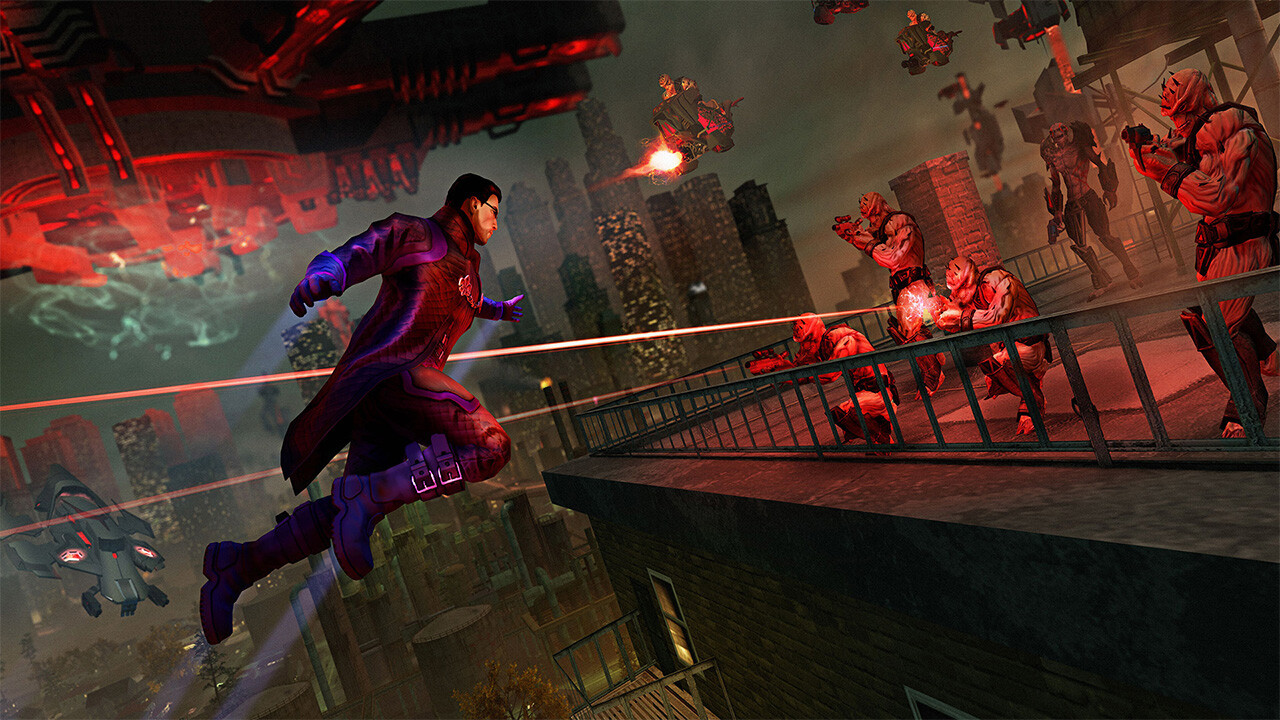
Saints Row IV came out in 2013 looking like a dare somebody forgot to retract. The Saints are in the White House. The main character is the President of the United States. An alien invasion locks everyone inside a Matrix-style simulation of a fictional American city. And somewhere inside that city, you can run at superhuman speed, throw people into orbit with telekinetic powers, and sing 'What Is Love' in a karaoke battle against an intergalactic warlord. Volition — the Champaign, Illinois studio that spent the early 2000s making the competent, unremarkable Red Faction games — had somehow arrived here. It is not subtle. It was never trying to be.
The game sold well, reviewed warmly, and then sort of slid into the part of collective memory reserved for titles people call 'underrated' without ever quite advocating for them loudly enough. The franchise itself collapsed later, and the less said about 2022's reboot the better. But Saints Row IV, specifically, deserves a fair accounting — not just of what it does with anarchic glee, but of where the seams show and whether any of that matters. Depending on your tolerance for a certain kind of rough, it might be exactly what your backlog needs. Or it might frustrate you into quitting before the second act opens up.
The Superpowers Are the Whole Point
There is a version of this game that kept the on-foot gunplay from Saints Row: The Third as its primary loop and added powers as a novelty layer. Volition did the smarter thing — they let the powers eat the gunplay entirely. Running at full sprint speed through a crowded street while chaining a ground stomp into a telekinetic throw into a freeze blast takes maybe two hours to feel natural, and after that the guns become almost ceremonial. You fire them for the sound design, because Saints Row IV has genuinely good weapon feedback, but the moment-to-moment movement is the real game.
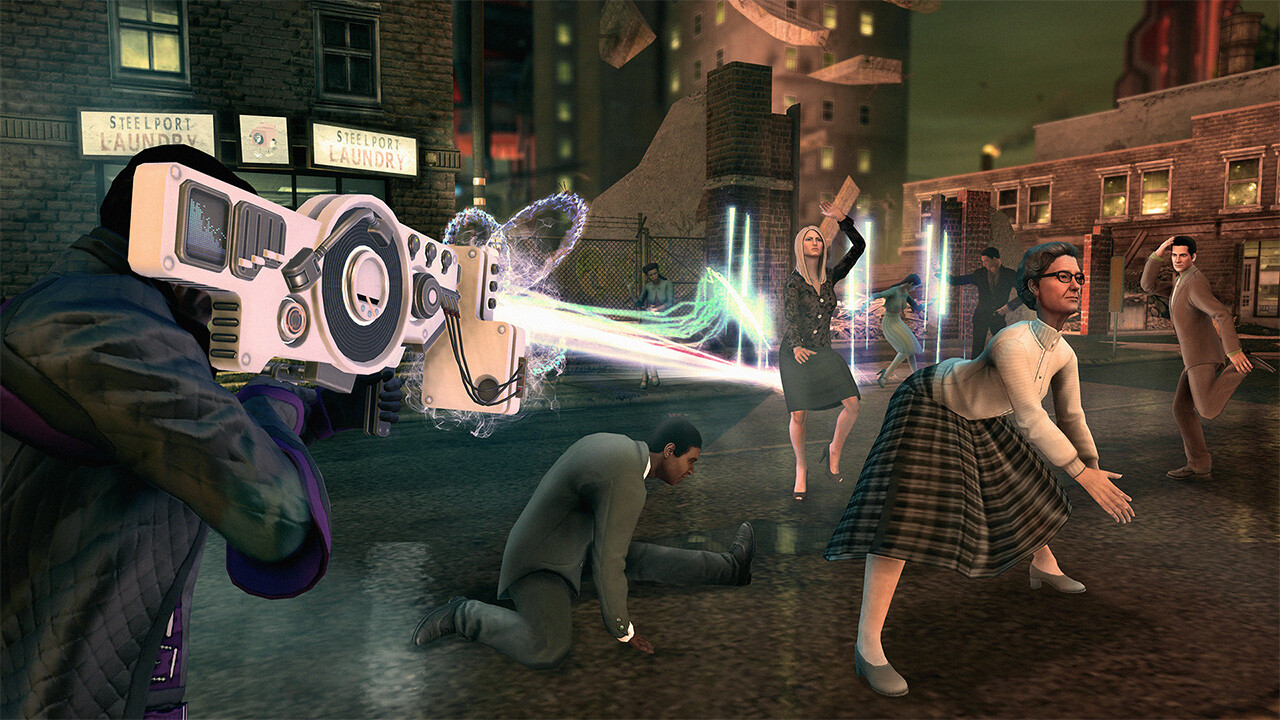 Scene from Saints Row IV.
The city simulation — Steelport, returning from The Third — is purpose-built for this. It is not a convincing urban environment. Buildings are spaced wide, blocks are long, and there is very little ground-level clutter to interrupt your momentum. That would be a design flaw in a grounded open-world game. Here it is a track. The vertical scale works because the sprint ability feeds into a glide that feeds into a jump upgrade tree, and the entire sequence of unlocks is paced well enough that you are always a session away from something that changes how you move. InFamous has the more polished version of this kind of traversal. Saints Row IV has more personality with it.
The Simulation Conceit Earns Its Keep
The Matrix framing is not just aesthetic cover for reusing Steelport — it actually lets the writing do things a grounded game cannot. When the simulation glitches, the sky turns wrong colors and enemy types shift. When you hack a simulation node, the surrounding geometry warps. These are small touches, but they give the world a reason to be unstable and strange without the game having to pretend that instability is tragedy. Other open-world games use weather systems or day/night cycles to create texture. Saints Row IV uses ontological dread, which is a funnier solution.
The story missions lean hard into this. Several of them are explicitly genre parody — there is a segment riffing on '50s sitcom suburbia, another that goes full survival horror with genuinely oppressive audio design — and because the simulation justifies any tonal register, the game can shift from comedy to something almost melancholy without it feeling like a mistake. Kinzie's loyalty missions have actual stakes. Keith David's presence as himself remains inspired casting. The writing is not consistent — some of the humor lands with the grace of a folding chair, and there are running jokes that overstay their welcome by about four repetitions — but the highs are high enough that the misses feel like the cost of swinging that hard.
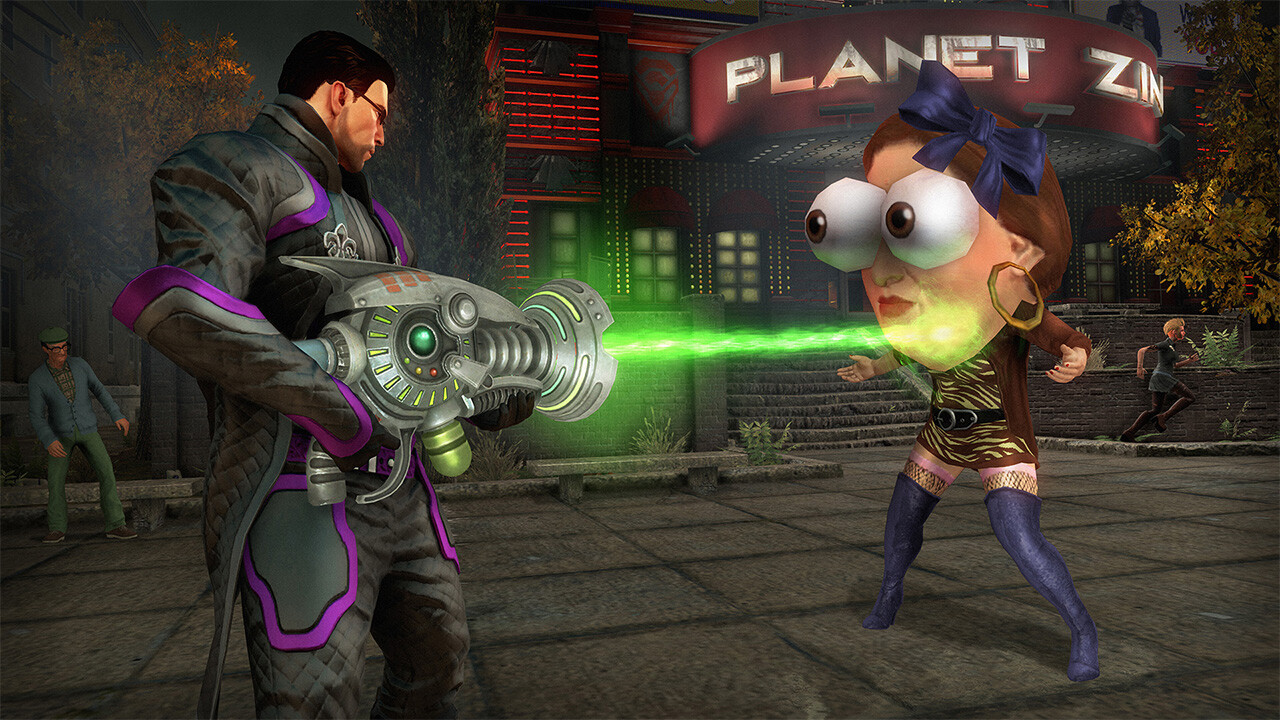 Scene from Saints Row IV.
The Side Activity Problem
Here is where the rough edges start accumulating. Saints Row IV inherits the side-activity structure from The Third — Insurance Fraud, Mayhem, Vehicle Theft, and so on — and these missions were already showing age in 2011. By 2013 they are vestigial. The movement system makes most of them feel mismatched: activities designed around driving become tedious when your character can outrun the car, and the on-foot chaos missions lose tension because you are too powerful to be threatened by the enemy density they throw at you.
The open-world collectibles are worse. There are clusters of data fragments scattered across Steelport for upgrade currency, and chasing them in the late game — when you have most of the power tree filled — stops feeling like play and starts feeling like inventory management. The radar marker system does not distinguish between story-critical objectives and these ambient pickups cleanly, and more than once I found myself circling a block at full sprint trying to locate a collectible the minimap had decided was directly underneath me. None of this is catastrophic. It is the kind of friction that a Ubisoft open world has normalized players into accepting, and Volition had not yet found a way around it.
Technical State and the Remaster Question
The original 2013 build had stability issues that Deep Silver partially addressed in subsequent patches, and the game has been available on PC via Steam in a state that is — fine. Frame rate on modern hardware is not a concern. The bigger issue is that Saints Row IV was designed on the Saints Row: The Third engine, which was already a modified version of an older codebase, and some of the geometry and texture work reflects that lineage visibly. Interior spaces in particular look underdeveloped compared to the outdoor environments. This is not a game you play for visual fidelity, but it is worth knowing that the gap between Saints Row IV and a contemporary open-world title is significant even accounting for the decade between them.
A remastered edition — Saints Row IV: Re-Elected — bundles the base game with DLC content and has been the default version on current platforms for a while. It does not overhaul the visuals meaningfully, but it does collect the extra story content, some of which is worth playing and some of which is extended-joke material that assumes a higher tolerance for the game's specific sense of humor than even fans reliably have. The Gat out of Hell standalone expansion, also bundled in some editions, is a separate question — shorter, shaggier, clearly a side project — and does not affect how the main game holds up.
What the Reboot Made Visible in Retrospect
The 2022 Saints Row reboot tried to pull the series back toward grounded crime fiction — younger characters, realistic financial stakes, a believable city. It is not a good game. But it is instructive about what Saints Row IV was actually doing right, which was committing to escalation without apology. The reboot is cautious. Saints Row IV is reckless. There is a mission in the fourth game where you defend Earth from alien attack using a ship turret while a power ballad plays without irony, and the game presents this as a reasonable thing that is happening. That confidence — the willingness to be completely ridiculous and still expect emotional investment — is genuinely difficult to manufacture. Most games that try this land on 'zany' instead.
Volition knew their characters well enough by the fourth entry that the absurdity had weight behind it. You are protecting people you have spent three games with. The alien antagonist, Zinyak, is a more coherent villain than most of the genre produces — his motivations are legible, his contempt for the Saints is specific. The comedy works partly because the dramatic structure underneath it is load-bearing. That is a harder trick than it looks.
Who This Is Actually For
If you played Saints Row: The Third and found the tone exhausting, Saints Row IV doubles everything you disliked and probably is not for you. If you found The Third charming but thin, IV is the version that puts real structure under the chaos — the power progression alone adds thirty hours of purposeful play that The Third never quite achieved. The combat sandbox at peak upgrade is one of the more joyful things you can do in an open-world game from that era, full stop. It is better than GTA V's on-foot combat even now, less buttoned-up than the Crackdown games, and more generous with its toolkit than InFamous Second Son.
The side activities will drag if you are a completionist. The visuals will remind you this is an older game. A few jokes land with the subtlety of a freight train. None of that changes the central fact: Saints Row IV understood that an open world is only as good as the moment-to-moment feel of moving through it, built a character who is genuinely fun to pilot, and wrapped all of it in a premise too deranged to forget. It is not a perfect game. It is a specific game — and in a genre full of cautious, well-produced sameness, that specificity still counts for something.
Editorial scoring
Reader Q&A
How long does it take to finish Saints Row IV Broke Every Rule and I Miss It Desperately?
Main story runs around 120 hours depending on how thoroughly you explore. Completionists can spend 2-3× that.
Is Saints Row IV Broke Every Rule and I Miss It Desperately good for newcomers to Open-World Comedy?
For total newcomers, expect a 5-8 hour ramp-up. Once you internalize the loop, it clicks.
Which platform should I play Saints Row IV Broke Every Rule and I Miss It Desperately on?
Console version is the most stable on launch. PC version benefits from the modding scene long-term.
Was Saints Row IV Broke Every Rule and I Miss It Desperately worth the launch-day price?
Depends on backlog. The replay value justifies the price for genre fans; casual players should wait for a 40%+ discount.
Are there DLCs or expansions worth picking up?
Wait for the Game of the Year edition — it bundles everything at a fair discount.
What did Volition get right (and what could be better)?
The systems are confident and the combat is satisfying. The story handoffs and load times are the rough spots.
Reader comments