Balatro Turned My Lunch Break Into a Felony
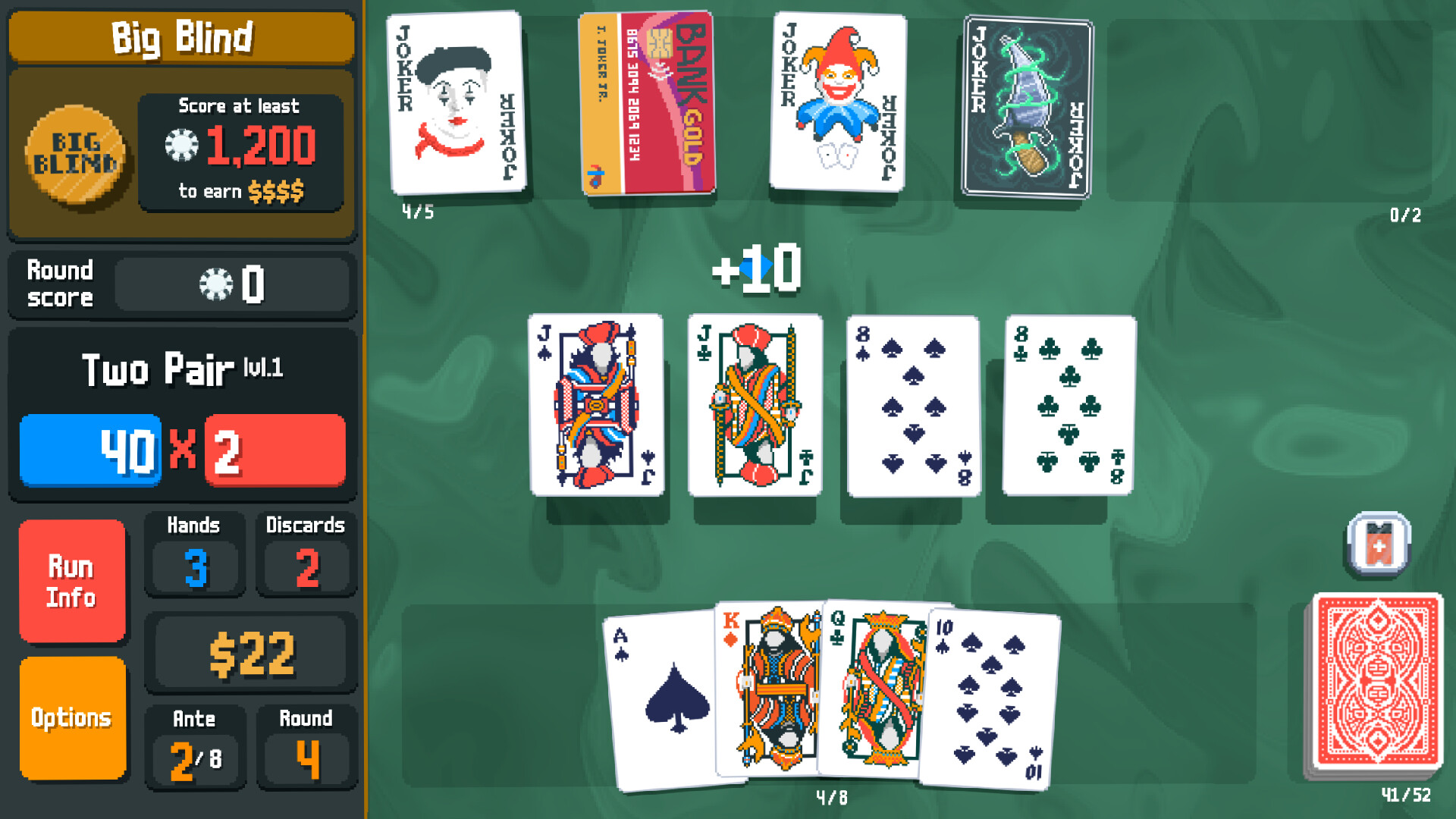
There is a specific moment in Balatro where you realize your whole strategy for the last twenty minutes was accidentally correct. You built a flush-heavy deck without meaning to, stumbled into a Joker that multiplies flush hands, and the numbers on screen start doing things that seem structurally unsound. The ante climbs. You keep going. Your sandwich gets cold.
LocalThunk's Balatro arrived in early 2024 as a solo-developer card game built around poker hand scoring, and it has since become one of those titles that people describe with the same slightly alarmed energy as a minor addiction. That framing is both accurate and slightly lazy. The more interesting question is what the game is actually doing mechanically that makes a forty-minute run feel like ten, and whether that machinery holds up past the initial novelty. It mostly does, with one or two asterisks worth discussing.
The Engine Under the Table
Balatro runs on a scoring system built from two values: chips and multiplier. Every hand scores chips based on the cards played, and a separate multiplier number amplifies that. The relationship between these two stats is multiplicative, not additive — which matters a lot. Nudging your multiplier from 4 to 8 doubles your score. Nudging it from 20 to 40 does something exponential when your chip count is already inflated. The game is, at its mechanical core, a lesson in how multiplying big numbers gets out of hand faster than adding them.
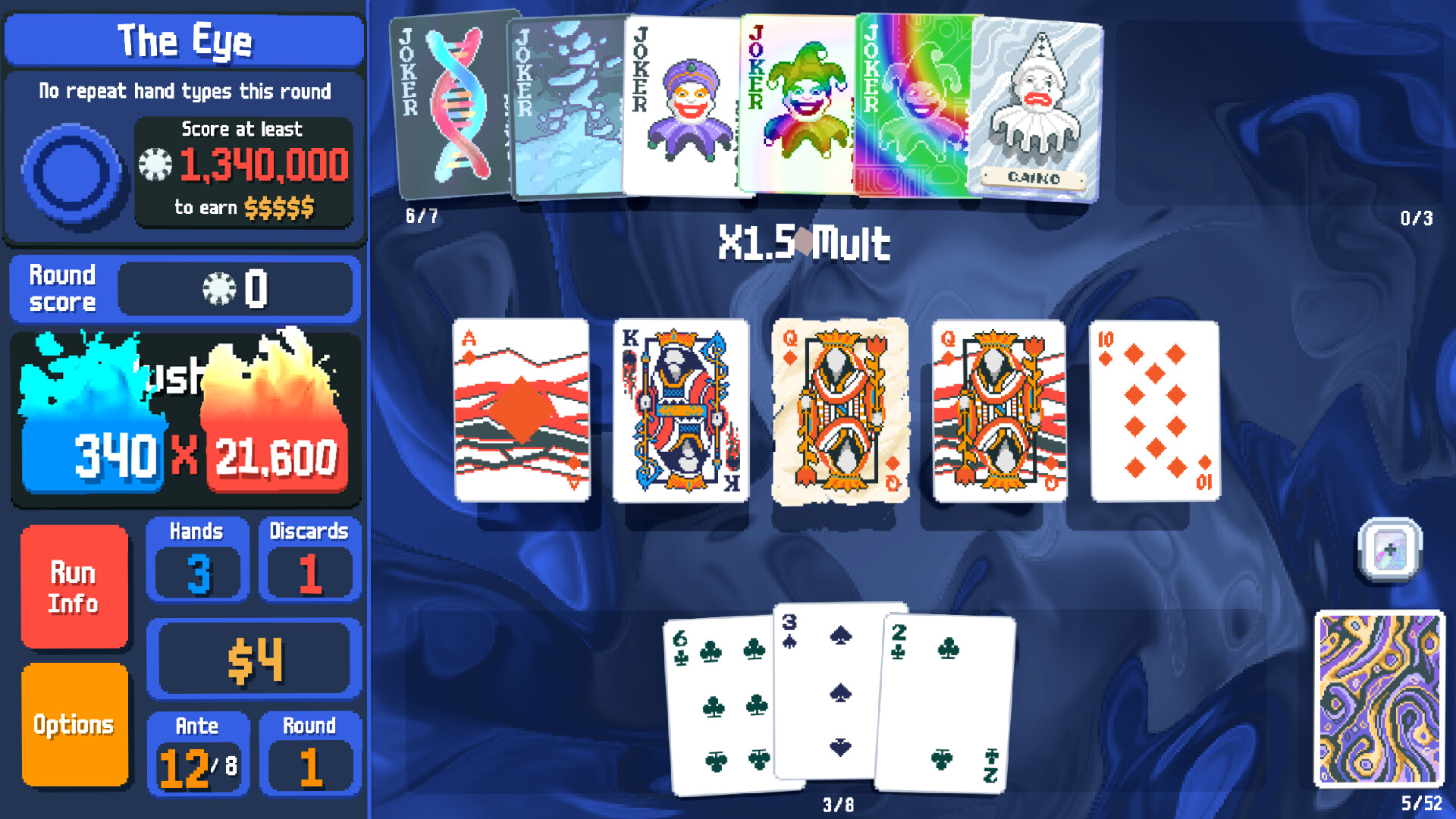 Scene from Balatro.
Jokers are the primary build-shaping tools. You can hold up to five at a time, and they range from simple flat bonuses to conditional triggers that rewrite how entire hand types function. Some Jokers care about suits. Some care about face cards. Some care about whether you played the same hand type four times in a row. Stacking compatible Jokers is where the actual design lives, and the game is generous enough with shop appearances that you will frequently get to act on a half-formed plan rather than just waiting for perfect pieces that never show.
The tarot and planet cards operate as a secondary layer. Tarots modify specific playing cards in your deck — sealing them, enhancing them, changing their suit. Planet cards level up hand types, permanently increasing the base chips and multiplier for every flush or straight you play for the rest of the run. Used well, these systems compress beautifully. A leveled-up hand type feeding a relevant Joker feeding an enhanced card in that same hand creates scoring moments that feel disproportionate to the inputs, which is exactly the feeling the game is chasing.
What the Deck-Builder Genre Usually Gets Wrong
Most games in this category — Slay the Spire, Monster Train, Inscryption's card sections — frame their core tension around combat attrition. You manage health, you manage energy, you survive. Balatro replaces that entirely with a scoring threshold. Each blind has a target number. Hit it in the allotted hands, move on. No hit points. No enemy attacks. The pressure is self-generated: can your deck reliably produce enough to clear a gate that keeps getting steeper?
 Scene from Balatro.
This is a real structural difference, and it changes the emotional texture of runs significantly. In Slay the Spire, a bad draw at the wrong moment can mean slow, visible death. In Balatro, a bad draw usually means you waste a hand and recount what you have left. The stakes feel different — not necessarily lower, but more internal. You are competing against a number on a screen rather than an animated enemy, and that distinction suits some players and bores others. Worth knowing going in.
The Blind Structure and When It Tightens
Each ante contains three blinds: two standard scoring gates and a boss blind with a special modifier that disrupts your strategy. Boss blinds are where the game gets sharp. Some debuff specific card suits, making a flush build temporarily unreliable. Others force you to play with a face-down hand, removing information. A few simply increase the score requirement to a level that feels punishing unless your build is already generating large numbers.
The skip mechanic adds real decision-making texture. You can skip any non-boss blind to claim a reward tag — a free Joker, a free tarot, extra money — without playing the hand. Early skips can accelerate a build meaningfully. But they also reduce the number of times you get to play hands, which matters if your Jokers rely on cumulative triggers. The tradeoff is genuine. Skipping feels bold and occasionally backfires in ways that are entirely your fault, which is the hallmark of good design.
The ante structure scales to eight by default in a standard run, with each boss blind demanding progressively larger scores. Where the game truly stretches is in its higher-difficulty stakes settings, which add debuffs and restrictions on top of the base structure. Getting there requires winning at each stake level first, so the difficulty gate is earned rather than optional from the start. That said, the jump between some stake levels can feel uneven — there are points where the required score scaling outpaces Joker availability in a way that reads less like challenge and more like friction.
The Shop Is Where Runs Live or Die
Between blinds, you visit a shop. You can buy Jokers, tarot packs, planet packs, standard card packs, and vouchers that modify shop behavior for the rest of the run. Money is tight early and, depending on your build, can stay tight. Some Jokers pay out per hand played. Some generate income for specific card plays. Building a small economic engine within your scoring engine is optional but often the difference between a run that stalls at ante five and one that compounds into something absurd.
Vouchers deserve attention here. They are permanent run upgrades that do things like add an extra Joker slot, reduce shop prices, or increase the cards available per pack. The Joker slot expansion in particular changes the arithmetic of a run enough that prioritizing it early is rarely wrong. Experienced players will have opinions about which vouchers are situationally correct versus generically strong, and that conversation is exactly the kind of depth the game earns.
Where It Gets Repetitive, Honestly
Balatro has over 150 Jokers in the pool, but runs will sometimes cycle through the same archetypes — flush builds, high-card multiplier builds, pair-focused builds — because the poker hand hierarchy naturally funnels toward flushes and straights being easier to engineer at scale. This is not a complaint about variety so much as a note that the theoretical build diversity is wider than what an average player will see in their first thirty hours. Some Joker combinations that look compelling in the collection screen are genuinely hard to trigger under real run conditions.
The game's visual style is confident and its sound design is frankly excellent — the audio feedback on big scoring moments has a satisfying weight that most games in this genre overlook. But Balatro is not trying to be Hades in terms of narrative density or Inscryption in terms of formal experimentation. It is a tight, focused scoring game. If that sounds like a limitation, it probably is for some audiences. If it sounds like a feature, it is.
So What Is It, Exactly
Balatro is the rare solo-developer game that feels like it was designed backward from a specific feeling rather than forward from a feature list. The target sensation — watching a number you built explode past what the game expected — is the product, and every mechanical decision serves it. The skip system, the shop economy, the multiplicative scoring, the Joker slot limit: all of it is load-bearing.
Whether it belongs in the same conversation as Slay the Spire or StS-adjacent games as a long-term staple is harder to say. The build variety is real but narrower than the Joker count implies. The difficulty curve is mostly well-tuned with some rough edges at higher stakes. The replayability depends heavily on whether the scoring feedback loop stays satisfying after the first dozen runs, and for a lot of players, it genuinely does.
The sandwich got eaten cold. The run cleared ante eight. Both things felt worth it at the time, which is probably the most honest summary available.
Editorial scoring
Reader Q&A
How long does it take to finish Balatro Turned My Lunch Break Into a Felony?
Main story runs around 85 hours depending on how thoroughly you explore. Completionists can spend 2-3× that.
Is Balatro Turned My Lunch Break Into a Felony good for newcomers to Roguelike Deck-builder?
It depends. The systems are deep but the tutorial does a fair job. Veterans of Roguelike Deck-builder will feel at home faster.
Which platform should I play Balatro Turned My Lunch Break Into a Felony on?
PC version offers the highest fidelity if your rig can handle it. Console versions are polished out of the box.
Was Balatro Turned My Lunch Break Into a Felony worth the launch-day price?
Released in 2024, and as of writing it holds up. Wait for a sale if you're price-sensitive — major discounts arrive within 6 months.
Are there DLCs or expansions worth picking up?
Wait for the Game of the Year edition — it bundles everything at a fair discount.
What did LocalThunk get right (and what could be better)?
The systems are confident and the combat is satisfying. The story handoffs and load times are the rough spots.
Reader comments